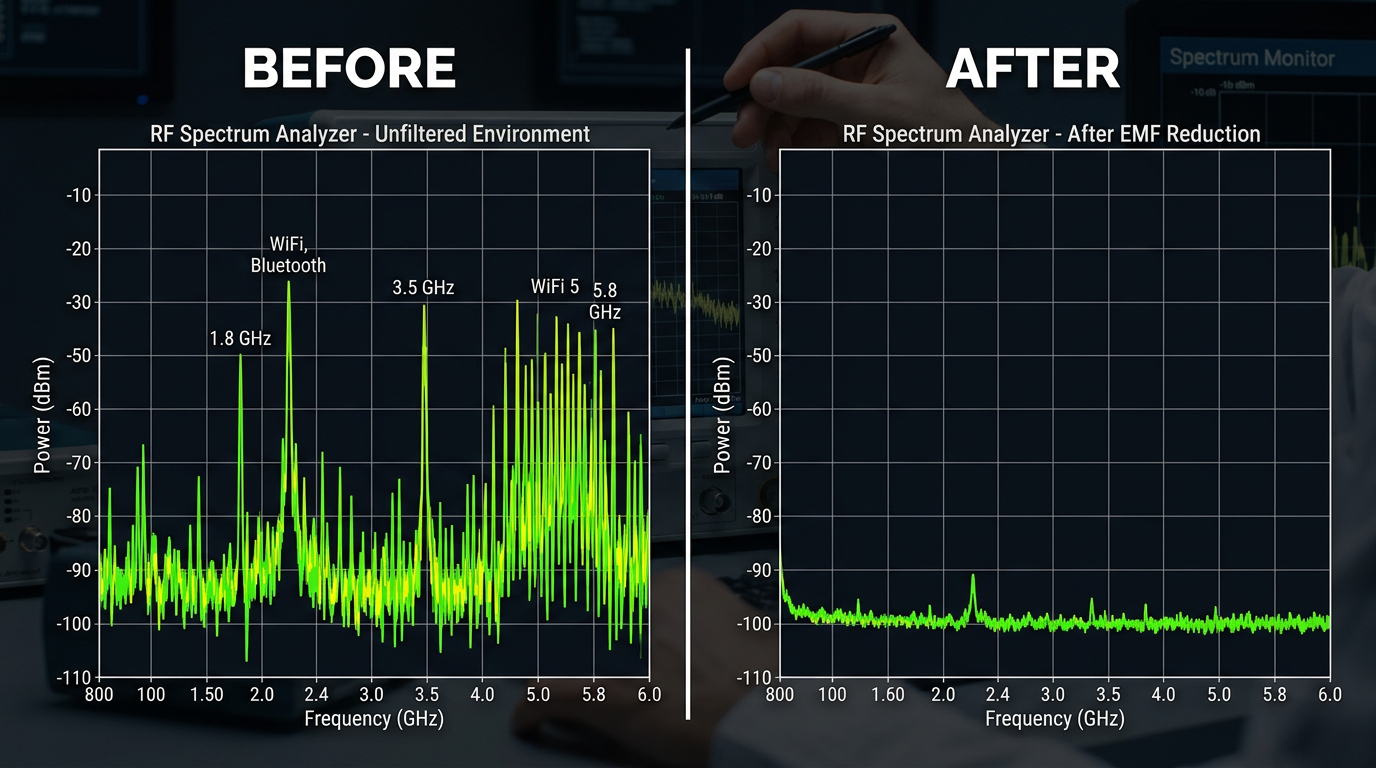
One of the most persistent questions in EMF science is this: if wireless signals are too weak to heat tissue, how could they possibly affect biology? For decades, the conventional answer was simple — they can't. But a growing body of research points to a specific mechanism that doesn't depend on heating at all. It centers on structures found in nearly every cell in your body: voltage-gated calcium channels (VGCCs).
What Are Voltage-Gated Calcium Channels?
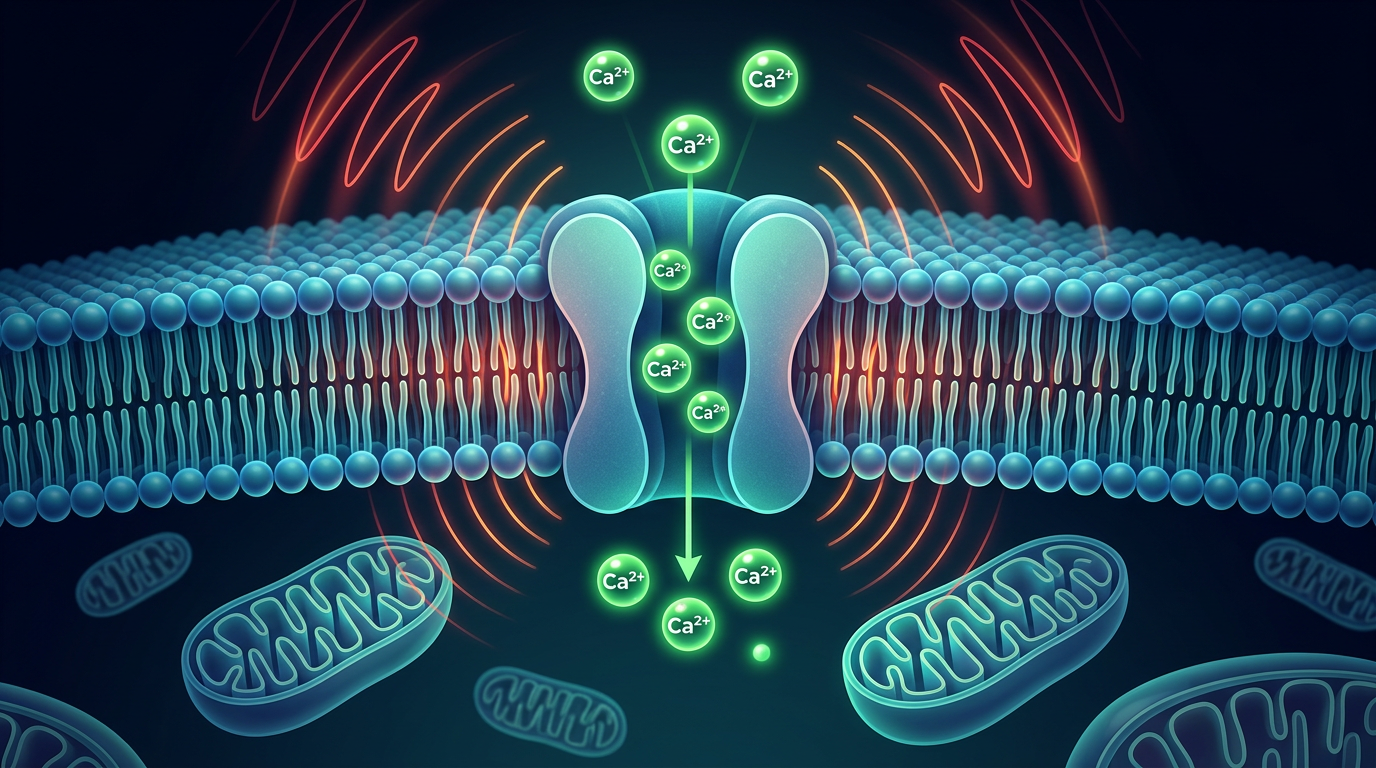
Voltage-gated calcium channels are protein structures embedded in cell membranes. They act as tiny gates that open and close in response to changes in electrical voltage across the membrane. When they open, calcium ions (Ca²⁺) flow into the cell from the extracellular space. This calcium influx is a fundamental biological signal — it triggers muscle contraction, neurotransmitter release, hormone secretion, and gene expression, among other processes.
Under normal conditions, these channels open and close in precisely regulated patterns. The cell maintains tight control over its internal calcium concentration because calcium is both essential for signaling and potentially damaging in excess. Too much intracellular calcium activates stress pathways, increases oxidative damage, and can impair mitochondrial function.
The VGCC Hypothesis: EMF as a Voltage Sensor Activator
In 2013, Dr. Martin Pall, Professor Emeritus of Biochemistry at Washington State University, published a detailed analysis in the Journal of Cellular and Molecular Medicine (PMC3780531) proposing that electromagnetic fields interact primarily with the voltage sensor of VGCCs — not with the cell as a whole.
The key insight is a matter of physics. The voltage sensor of a VGCC is an extraordinarily sensitive structure. It contains a series of positively charged amino acids embedded in a narrow channel within the cell membrane. Due to the thinness of the membrane (about 7 nanometers), even a modest external electric field translates into a very large force on these charged residues. Pall calculated that the forces on the voltage sensor are approximately 7.2 million times stronger than those on singly charged groups elsewhere in the cell.
This means the voltage sensor acts as a natural amplifier. An electromagnetic field that is far too weak to heat tissue or move ions through the cytoplasm could still exert meaningful force on the VGCC voltage sensor, causing the channel to open when it otherwise wouldn't.
The Downstream Cascade
When VGCCs open inappropriately and allow excess calcium into the cell, a well-characterized biochemical cascade follows:
- Calcium binds to calmodulin — a calcium-sensing protein present in all cells
- The calcium/calmodulin complex activates nitric oxide synthase — producing nitric oxide (NO), which is a useful signaling molecule in small quantities
- Excess nitric oxide reacts with superoxide — forming peroxynitrite (ONOO⁻), a highly reactive nitrogen species
- Peroxynitrite causes oxidative stress — damaging lipids, proteins, and DNA, and impairing mitochondrial electron transport
This is not a speculative chain of events. Each step is well-established in mainstream biochemistry. What Pall's hypothesis adds is a plausible trigger mechanism connecting EMF exposure to the first step in the cascade.
The Evidence: Calcium Channel Blockers
Perhaps the most compelling line of evidence supporting this hypothesis is pharmacological. Pall's 2013 review identified 23 separate studies showing that calcium channel blocking drugs — the same medications used to treat high blood pressure — could block or reduce the biological effects of EMF exposure in cell and animal models.
The logic is straightforward: if EMF effects are mediated through VGCCs, then blocking those channels should prevent the effects. And across two dozen independent studies, that's exactly what researchers found. This consistency across different labs, different exposure parameters, and different biological endpoints provides substantial support for the mechanism.
Why the Nervous System May Be Most Sensitive
VGCCs are not evenly distributed throughout the body. They are found in the highest density in the nervous system — the brain, spinal cord, and peripheral nerves. Neurons rely heavily on precise calcium signaling for synaptic transmission, plasticity, and survival. This is why the VGCC mechanism has particular implications for neurological function and, by extension, for sleep.
During sleep, the brain undergoes essential maintenance: consolidating memories, clearing metabolic waste through the glymphatic system, and restoring neurotransmitter balance. These processes depend on orderly neuronal signaling, which in turn depends on properly regulated calcium dynamics. If VGCC activation during sleep introduces even modest calcium dysregulation in neural tissue, it could subtly impair these restorative processes.
This is one reason why reducing EMF exposure in the bedroom — where you spend the most continuous time and where your nervous system is engaged in its most sensitive work — may be particularly meaningful.
Genetic Variation: The CACNA1C Connection
A 2025 study by Sousouri and colleagues, published in NeuroImage, added an important new dimension to this research. The study examined how genetic variation in the CACNA1C gene — which encodes a major subtype of voltage-gated calcium channel — influences brain responses to 5G radiofrequency exposure.
The researchers found that individuals with certain CACNA1C genotypes showed different patterns of neural activity when exposed to RF signals compared to those with other genotypes. This suggests that sensitivity to electromagnetic fields may not be uniform across the population — some people may be genetically predisposed to greater VGCC-mediated responses.
This finding has significant implications. It helps explain why studies of EMF effects sometimes show inconsistent results across populations: if genetic variation modulates the response, averaging across genetically diverse participants could mask real effects in susceptible subgroups. It also supports the common observation that some individuals report noticeable sensitivity to wireless devices while others perceive no effect at all.
The Mainstream Position and Where It Stands
It is important to present this topic with appropriate balance. The current position of the International Commission on Non-Ionizing Radiation Protection (ICNIRP), updated in their 2020 guidelines, maintains that the only established mechanism by which radiofrequency fields affect biological tissue is through thermal effects — heating. Their exposure limits are set to prevent tissue heating, and they consider the evidence for non-thermal mechanisms to be insufficient for regulatory purposes.
The VGCC hypothesis, while supported by a substantial body of cell and animal research, has not yet been universally accepted by regulatory bodies. Critics note that many of the supporting studies are in vitro (cell cultures) or animal models, and that translation to real-world human exposure scenarios requires caution. The 23 calcium channel blocker studies, while consistent, vary in methodology and exposure conditions.
This is an active area of scientific investigation. New studies continue to be published, and the 2025 CACNA1C genotype research represents an important step toward understanding individual variability. The science is evolving, and responsible interpretation means neither dismissing the evidence nor overstating it.
What This Means for Your Bedroom
The VGCC mechanism provides a biophysically plausible pathway through which non-thermal EMF exposure could affect cellular function — particularly in the nervous system, where calcium channels are most abundant and calcium regulation is most critical.
Whether this mechanism produces clinically significant effects in every person at typical household exposure levels is still being determined. But the precautionary reasoning is clear: given that the nervous system is most active in repair during sleep, and given that VGCCs are most dense in neural tissue, reducing EMF exposure in the bedroom during sleep hours represents a rational, low-cost precaution.
You don't need to fully resolve the scientific debate to act on it. Turning off WiFi at night, moving wireless devices away from your bed, and minimizing pulsed RF signals in your sleep environment are simple steps that cost nothing and carry no downside — while potentially allowing your cells to regulate calcium signaling without external electromagnetic interference.
Key Takeaways
- Voltage-gated calcium channels (VGCCs) are sensitive to electromagnetic fields through their voltage sensor — a natural amplifier in the cell membrane
- Twenty-three independent studies show that calcium channel blockers prevent EMF biological effects, supporting the VGCC mechanism
- Excess calcium influx triggers a cascade ending in oxidative stress and potential mitochondrial impairment
- The nervous system has the highest VGCC density, making sleep — when neural repair is at its peak — a period of particular relevance
- Genetic variation in the CACNA1C gene may explain why some individuals are more sensitive than others
- The mainstream position (ICNIRP 2020) focuses on thermal effects; the VGCC hypothesis represents an active and evolving area of research
- Reducing bedroom EMF during sleep is a low-cost, no-downside precaution supported by the precautionary principle