Most people understand, at least intuitively, that light affects sleep. Bright screens before bed make it harder to fall asleep. Morning sunlight helps you feel alert. But the relationship between light, electromagnetic energy, and your body's internal clock goes much deeper than these everyday observations suggest. Understanding the full picture reveals why your bedroom's electromagnetic environment — not just its visible light — may be one of the most consequential factors in sleep quality.
The Circadian System: Your Body's Master Clock
At the core of your sleep-wake cycle is the suprachiasmatic nucleus (SCN), a tiny cluster of about 20,000 neurons located in the hypothalamus, directly above where the optic nerves cross. The SCN is your body's master clock, coordinating circadian rhythms across every organ and tissue. It sets the timing for hormone release, body temperature fluctuation, immune function, gene expression, and metabolic cycles — all on an approximately 24-hour schedule.
The SCN receives its primary timing signal from a specialized set of cells in the retina called intrinsically photosensitive retinal ganglion cells (ipRGCs). Unlike the rods and cones responsible for vision, ipRGCs contain a photopigment called melanopsin, which is specifically tuned to detect the intensity and spectral composition of ambient light. Melanopsin is most sensitive to blue wavelengths — roughly 460 to 480 nm — which correspond to the dominant frequency of midday skylight.
This is the elegant mechanism by which your body synchronizes with the solar cycle: morning sunlight, rich in blue wavelengths, signals to the SCN that daytime has begun. The SCN responds by suppressing melatonin production, increasing cortisol, raising body temperature, and initiating the cascade of daytime physiological processes.
Morning Light: Setting the Clock
The morning light signal is not just about waking up. It's about calibrating the entire circadian system for the day ahead. When sunlight enters your eyes in the morning — particularly the UV-A and infrared wavelengths present between roughly 9 and 11 AM — it triggers a series of photobiological processes that extend far beyond the SCN.
Morning UV-A exposure on the skin and eyes helps initiate the production of precursors used in melatonin synthesis later that night. Infrared wavelengths from sunlight penetrate tissue and interact with mitochondrial cytochrome c oxidase, supporting cellular energy production. The full-spectrum nature of sunlight provides information that artificial light simply cannot replicate — it tells your body not just that it's daytime, but what time of day it is and what season it is.
This is why many sleep researchers emphasize the importance of getting outside in the morning without sunglasses for at least 10-20 minutes. The circadian system evolved to receive a strong, natural light signal early in the day. Without it, the entire timing system begins to drift.
After Sunset: The Melatonin Cascade
As daylight fades in the evening, the SCN registers the declining blue light signal and begins a carefully orchestrated transition. Approximately 2-3 hours after sunset — in the absence of artificial light — the pineal gland initiates the melatonin cascade.
Melatonin is far more than a sleep hormone. It is one of the most potent antioxidants produced by the human body, with a particular affinity for mitochondria — the energy-producing organelles in every cell. During sleep, melatonin:
- Scavenges free radicals directly within mitochondria, protecting the electron transport chain from oxidative damage
- Activates DNA repair enzymes, supporting the correction of mutations and cellular damage accumulated during waking hours
- Regulates body temperature — the slight drop in core temperature during sleep is partly melatonin-mediated and is essential for deep, restorative sleep stages
- Modulates immune function, supporting the nighttime immune surveillance that identifies and eliminates abnormal cells
- Facilitates the glymphatic system — the brain's waste-clearance mechanism that operates primarily during sleep
Melatonin secretion requires sustained darkness. Research suggests that the full melatonin cascade requires approximately four hours of darkness before melatonin levels reach their peak. This is known as the dim-light melatonin onset (DLMO) window, and it represents one of the most well-established chronobiological findings in sleep science.
Blue Light: The Familiar Disruptor
The disruptive effect of artificial blue light on melatonin production is by now well documented. Screens (phones, tablets, laptops, televisions) and LED lighting emit concentrated energy in the 435-465 nm range — directly within melanopsin's peak sensitivity band. Exposure to these wavelengths after sunset sends a daytime signal to the SCN, suppressing melatonin release and delaying sleep onset.
This is why blue-light-blocking glasses and "night mode" screen filters have become popular interventions. They reduce the blue wavelengths reaching the retina, allowing the circadian system to transition more naturally toward sleep. These are sensible steps, and the research supporting them is robust.
But visible light is only part of the electromagnetic spectrum present in a modern bedroom.
Beyond Visible Light: The Broader Electromagnetic Environment
Here is where the picture becomes more nuanced and where emerging research invites us to think more broadly. Visible light occupies a narrow band of the electromagnetic spectrum — roughly 380 to 700 nm. WiFi signals, Bluetooth, cellular signals, and other wireless transmissions occupy frequencies in the gigahertz range — billions of cycles per second, with wavelengths measured in centimeters rather than nanometers.
These are all forms of electromagnetic radiation. They differ in frequency and wavelength, but they are all part of the same physical phenomenon. The question that researchers are beginning to explore is whether the body's electromagnetic sensing systems — evolved to respond to the natural spectrum — may also respond to non-native frequencies in ways that affect circadian function.
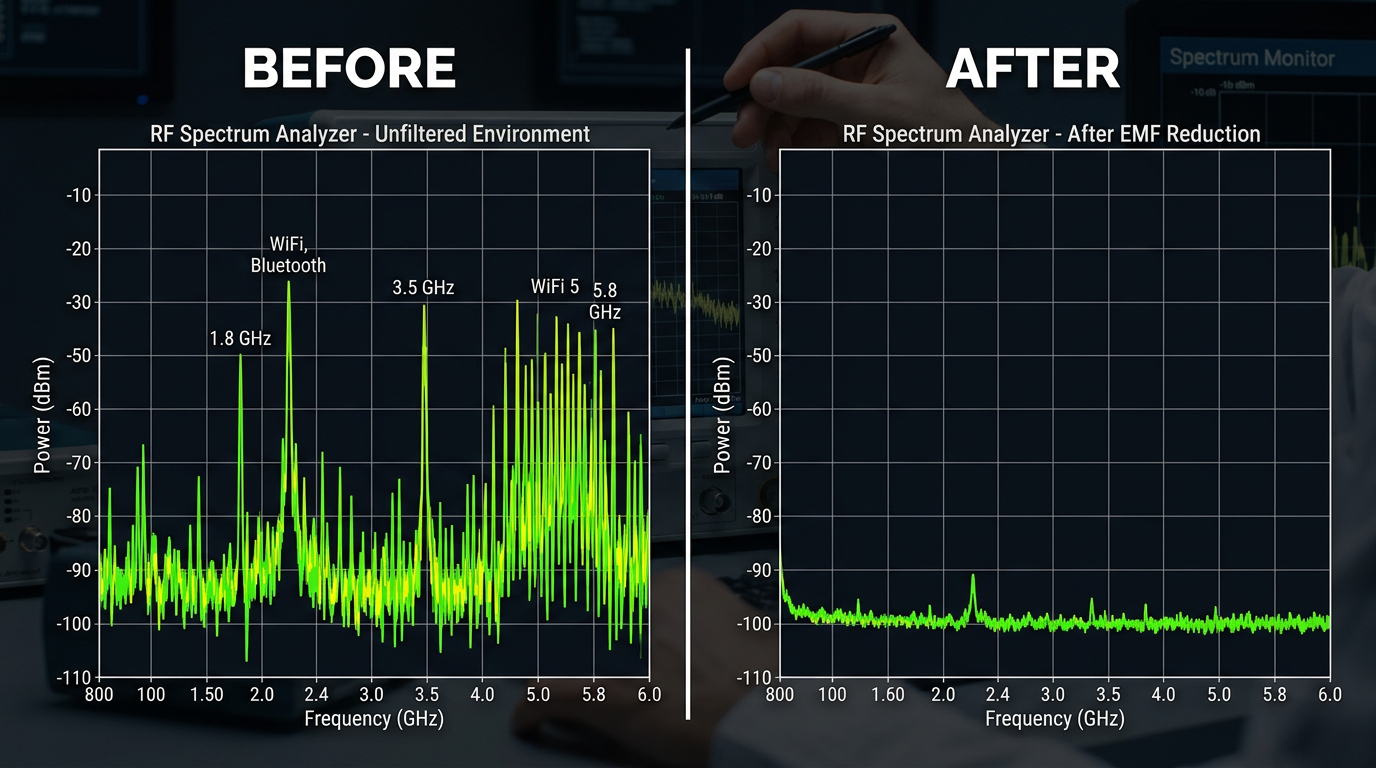
Several studies have investigated the relationship between radiofrequency exposure and melatonin production. While results are mixed and the field is still developing, some research has found measurable changes in melatonin levels or its metabolites in individuals exposed to RF signals during sleep. The mechanisms proposed include direct effects on the pineal gland and indirect effects mediated through calcium signaling pathways.
This research is not yet definitive, and responsible interpretation requires acknowledging the inconsistencies across studies. But the conceptual framework is sound: if the circadian system is an electromagnetic sensing system — which it demonstrably is, in its response to light — then it is not unreasonable to investigate whether it also responds to other portions of the electromagnetic spectrum.
Creating an Optimal Sleep Environment
The practical implications of circadian science converge on a clear set of recommendations for the bedroom environment. A 2024 study by Bijlsma and colleagues, using the Pittsburgh Insomnia Rating Scale (PIRS-20), found measurable improvements in subjective sleep quality when participants reduced their exposure to 2.45 GHz signals during sleep — adding to the evidence that the electromagnetic environment of the bedroom has practical relevance.
A science-informed sleep protocol addresses both the visible and non-visible portions of the spectrum:
- Morning sunlight exposure: Get outside for 10-20 minutes within the first hour of waking, without sunglasses if safe to do so. This sets the circadian clock with a strong, natural signal.
- Blue light management after sunset: Use blue-light-blocking glasses or amber-tinted bulbs in the evening. Minimize screen time in the two hours before bed, or use blue-light filters on all devices.
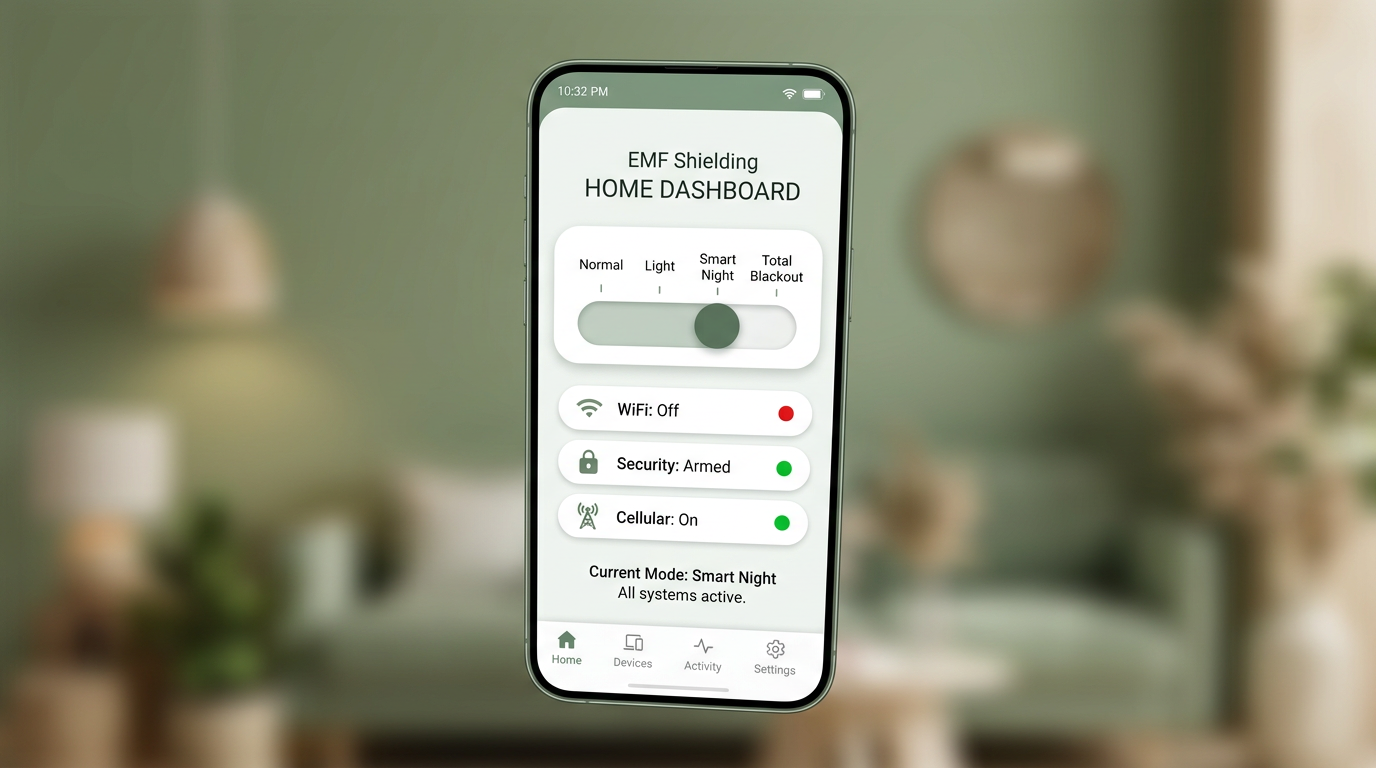
- WiFi and wireless devices off at night: Put your router on a timer or use a Home Assistant automation to disable WiFi during sleep hours. Switch phones to airplane mode. Remove or power down Bluetooth devices in the bedroom.
- Complete bedroom darkness: Use blackout curtains to eliminate streetlights and ambient light. Cover any LED indicator lights on devices. Even small amounts of light can suppress melatonin through the eyelids.
- Honor the four-hour darkness window: Begin dimming lights and reducing electromagnetic stimulation at least four hours before your intended sleep time to support the full melatonin cascade.
An Integrated View
The circadian system is your body's most fundamental environmental interface. It evolved to read the electromagnetic signals of the natural world — primarily visible light — and translate them into the precise hormonal, metabolic, and neurological timing that makes restorative sleep possible.
Modern life has introduced two disruptions to this system: artificial visible light (particularly blue-enriched LED and screen light) and non-native electromagnetic fields in the radiofrequency range. The first disruption is well established in the scientific literature. The second is an active area of investigation with a plausible biophysical basis and growing — though not yet conclusive — supporting evidence.
Addressing both disruptions in the bedroom is straightforward, low-cost, and carries no practical downside. Whether you think of it as circadian hygiene, sleep optimization, or electromagnetic housekeeping, the goal is the same: give your body's master clock the clearest possible signal that nighttime has arrived, and let it do the rest.
Key Takeaways
- The SCN and melanopsin-containing retinal cells form an electromagnetic sensing system that sets circadian timing based on light
- Morning sunlight — particularly UV-A and infrared — calibrates the circadian system and initiates melatonin precursor synthesis
- Melatonin is far more than a sleep hormone: it is a mitochondrial antioxidant, DNA repair activator, and immune modulator
- Full melatonin secretion requires approximately four hours of sustained darkness
- Blue light from screens and LEDs suppresses melatonin by activating melanopsin receptors after sunset
- Emerging research is investigating whether non-visible EMF (WiFi, cellular) may also interact with circadian and melatonin systems
- A comprehensive sleep protocol addresses both visible light and radiofrequency exposure in the bedroom