When most people think of EMF testing, they picture someone walking around with a meter that shows a single number. That number — usually total RF power density — is useful, but it only tells part of the story. To truly understand your bedroom's electromagnetic environment, you need to see what's behind that number. That's where a spectrum analyzer comes in.
Broadband RF Meter: The Total Picture
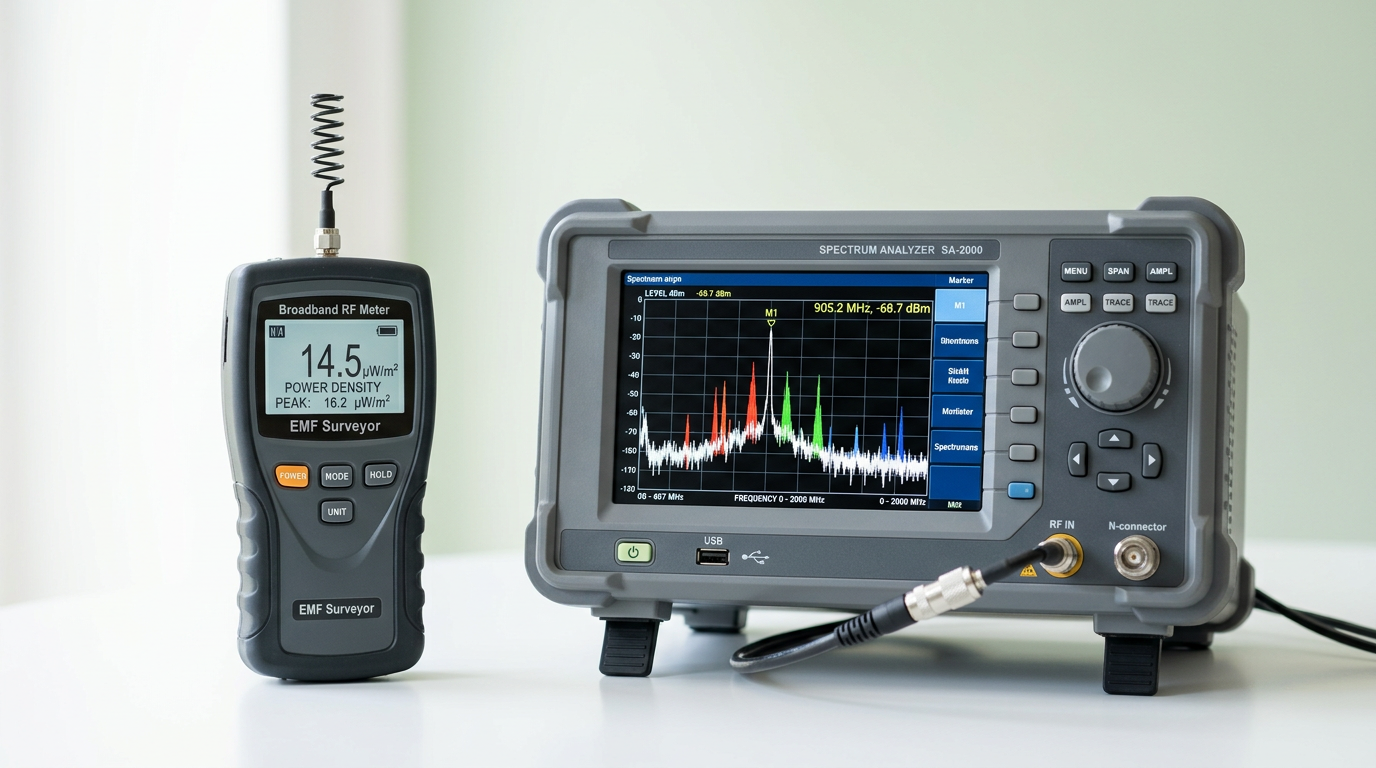
A broadband RF meter measures the total RF power density across a wide frequency range. Think of it as a rain gauge: it tells you how much total "rain" is falling, but it can't tell you whether it's coming from one big cloud or ten small ones.
Broadband meters are essential for establishing a baseline. They give you a single, comparable number that represents the overall RF environment at a specific location. When you see a measurement like "250 μW/m² at pillow level," that's a broadband reading.
These meters are calibrated, reliable, and relatively straightforward to use. They answer the fundamental question: how much total RF energy is present here?
But they don't answer the next question: where is it coming from?
Spectrum Analyzer: The Source Identification Tool
A spectrum analyzer breaks the RF environment down by frequency. Instead of showing one total number, it displays a graph — a visual representation of exactly which frequencies are present and how strong each one is.
This is transformative for EMF assessment because every wireless technology operates on specific, identifiable frequencies:
- 2.4 GHz — WiFi (802.11 b/g/n/ax), Bluetooth, baby monitors, microwave ovens
- 5 GHz — WiFi (802.11 ac/ax), some cordless phones
- 900 MHz — Some smart meters, older cordless phones, certain IoT devices
- 700–2100 MHz — Cell tower signals (4G LTE bands)
- 3.5 GHz — 5G mid-band (C-band)
- 600 MHz — 5G low-band, some TV broadcast signals
When you look at a spectrum analyzer display, you can literally see each source as a distinct peak on the frequency graph. A WiFi router shows up as a characteristic pattern at 2.4 or 5 GHz. A cell tower appears as a peak in the 700-2100 MHz range. A smart meter pulses at 900 MHz.
Why This Matters for Remediation
Here's a scenario that illustrates why spectrum analysis is essential:
Imagine a bedroom with a broadband reading of 400 μW/m². That's the total. Now, without spectrum analysis, you might assume the WiFi router is the primary source and focus your effort there. But when you run the spectrum analyzer, you discover something different:
- WiFi (2.4 GHz): 80 μW/m²
- WiFi (5 GHz): 40 μW/m²
- Cell tower (1900 MHz): 250 μW/m²
- Smart meter (900 MHz): 30 μW/m²
In this case, the dominant source isn't the WiFi router at all — it's a nearby cell tower. Turning off the WiFi would only reduce the total by about 30%. The rest of the exposure would require different solutions, like RF-shielding film on the window facing the tower.
Without spectrum analysis, you'd invest time and effort in the wrong intervention. With it, you can prioritize effectively and verify that each intervention is addressing the actual source.
Visual Before/After Documentation
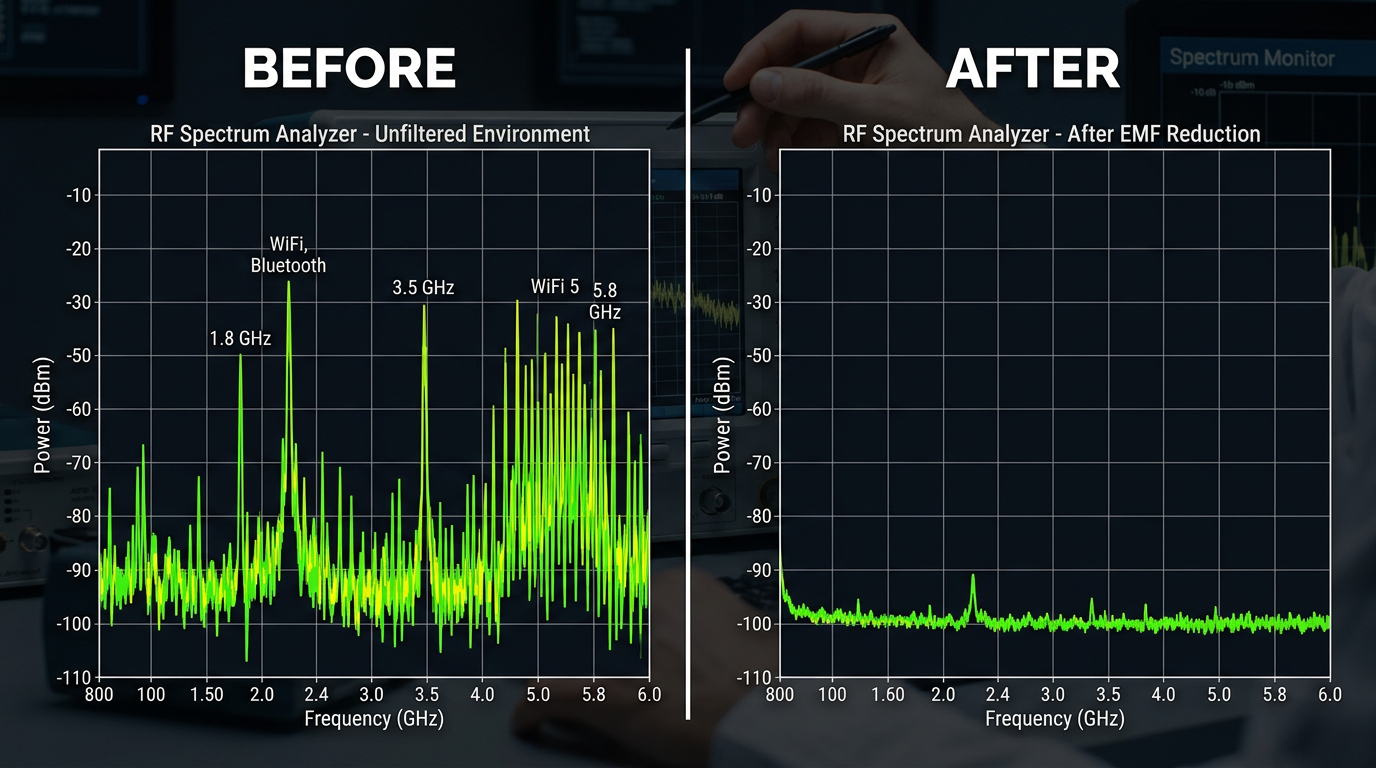
One of the most powerful aspects of spectrum analysis is the ability to produce visual before-and-after comparisons. These aren't just numbers on a page — they're graphs that clearly show which frequencies were present before intervention and how they changed afterward.
This kind of documentation provides something invaluable: transparent proof. When a client can see that the 2.4 GHz peak dropped from 200 μW/m² to less than 1 μW/m² after their WiFi was automated to shut off at night, the result isn't abstract — it's visible and verifiable.
Before-and-after spectrum graphs also help identify unexpected sources. Sometimes the "after" measurement reveals a signal that was previously masked by the dominant source. A Bluetooth device you forgot about. A neighbor's WiFi that bleeds through a shared wall. A wireless security sensor that you assumed was wired. Spectrum analysis catches these because it shows the full picture at every frequency.
The Dual-Tool Approach
Professional EMF assessment at its best uses both tools together:
- Broadband meter first: Establish the total power density at key locations — pillow level, center of bed, nightstand height. This gives you the baseline numbers.
- Spectrum analyzer second: Identify which sources are contributing to those numbers. Map the frequency landscape of the room.
- Targeted intervention: Address the specific sources identified by the spectrum analyzer, starting with the highest contributors.
- Post-intervention verification: Re-measure with both tools to confirm the reduction and document the results.
This dual-tool methodology is what separates a professional assessment from a basic meter reading. Many EMF testing services use only a broadband meter — which gives you a number but not a plan. The spectrum analyzer turns measurement into actionable intelligence.
What to Look for in a Professional Assessment
If you're considering an EMF assessment for your bedroom, ask about the equipment being used. A thorough assessment should include:
- A calibrated broadband RF meter with documented measurement methodology
- A spectrum analyzer capable of identifying signals from at least 100 MHz to 6 GHz
- Measurements at multiple positions (pillow level is the most important for sleep)
- Source identification for every significant contributor to total power density
- Before-and-after documentation showing the effect of each intervention
The difference between a service that uses one meter and a service that uses both is the difference between knowing your exposure number and understanding your exposure environment. Both matter, but understanding drives better results.
Key Takeaways
- A broadband RF meter measures total power density — essential but incomplete
- A spectrum analyzer reveals which specific sources contribute to that total
- Every wireless technology has a unique frequency signature that spectrum analysis can identify
- Source identification enables targeted, effective intervention rather than guesswork
- Before-and-after spectrum graphs provide transparent, visual proof of results
- Professional assessment should always include both measurement tools